
Payout Disputes in Retail Prop Trading
Why payout requests become contested — and what documented cases reveal
- Coverage
- GLOBAL
- Period
- H1 2026
- Extent
- 9 pages
- Publication
- PTC-IS-2026-02
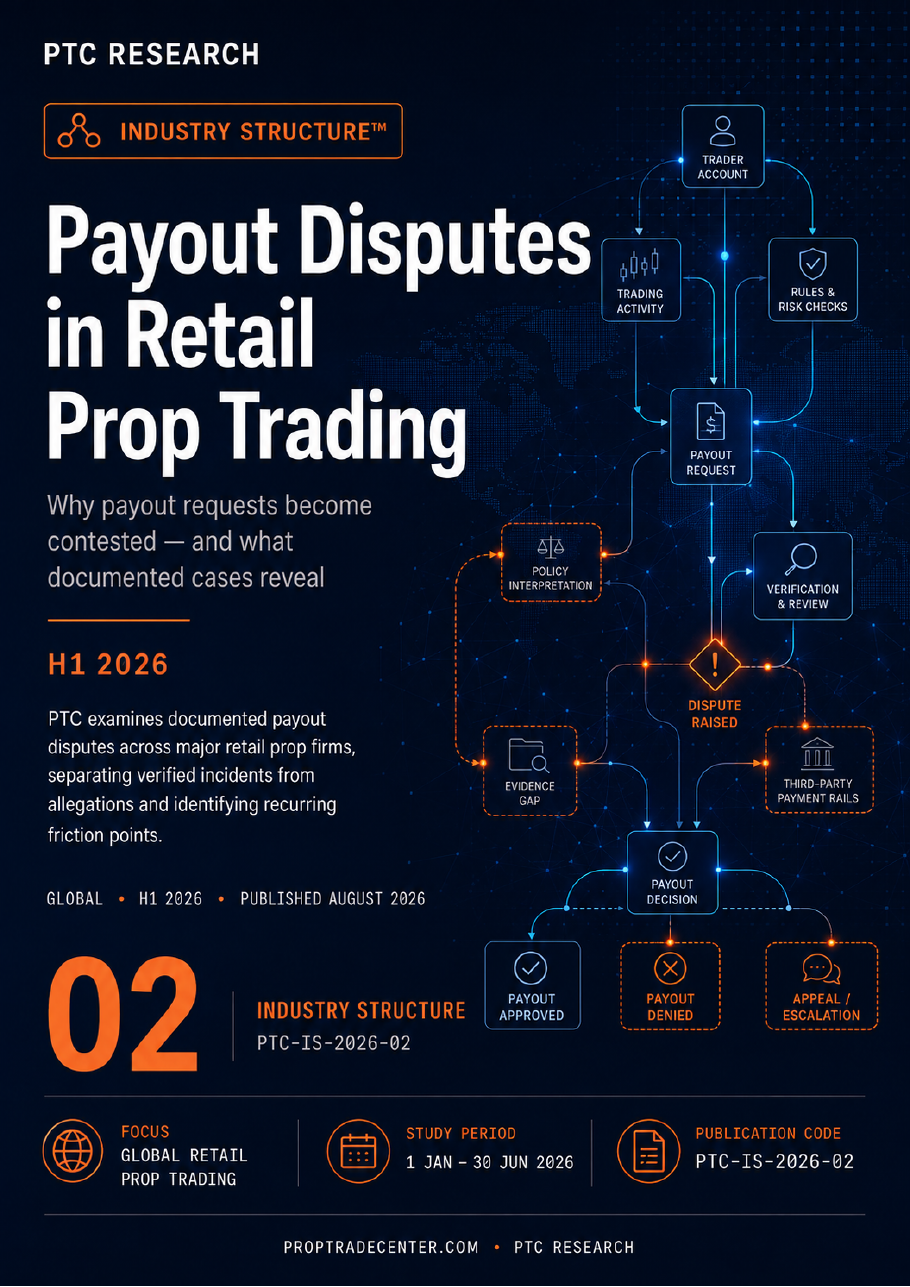
H1 2026 evidence does not support a broad industry-wide pattern of refused payouts; documented disputes concentrate in rule interpretation, KYC and identity review, processing delays and account investigations.
What this report covers
PTC examines documented H1 2026 payout disputes to identify why payouts become contested, including trading-rule interpretation, KYC and identity reviews, processing delays and account investigations.
- Payout dispute categories
- Trading-rule interpretation
- KYC and identity review
- Payout processing and backlogs
- Account reviews and terminations
What the research found
- Trading-rule interpretation was the most frequently documented dispute category in the researched firm set.
- KYC and identity verification recurred as a friction point, sometimes close to payout eligibility.
- Processing backlogs delayed payouts without establishing that a firm refused to pay.
- Third-party compliance and payment providers were a decision point in at least one documented case.
- No defensible primary-source denominator exists to convert public complaint counts into a payout failure rate.
Why do prop-firm payout requests become contested?
The full report sets out the documented H1 2026 dispute record firm by firm, separating verified incidents and firm acknowledgments from trader allegations, and identifies the recurring friction points behind contested payouts.
Documented disputes only — not a firm-level payout-reliability ranking.
Evidence is drawn from public records, firm statements and trader-reported cases. The research makes no finding of fraud or misconduct against any named firm and does not estimate a firm-level or industry-wide probability of payout.
PTC Research #02 · PTC-IS-2026-02 · Research cutoff 30 JUNE 2026