
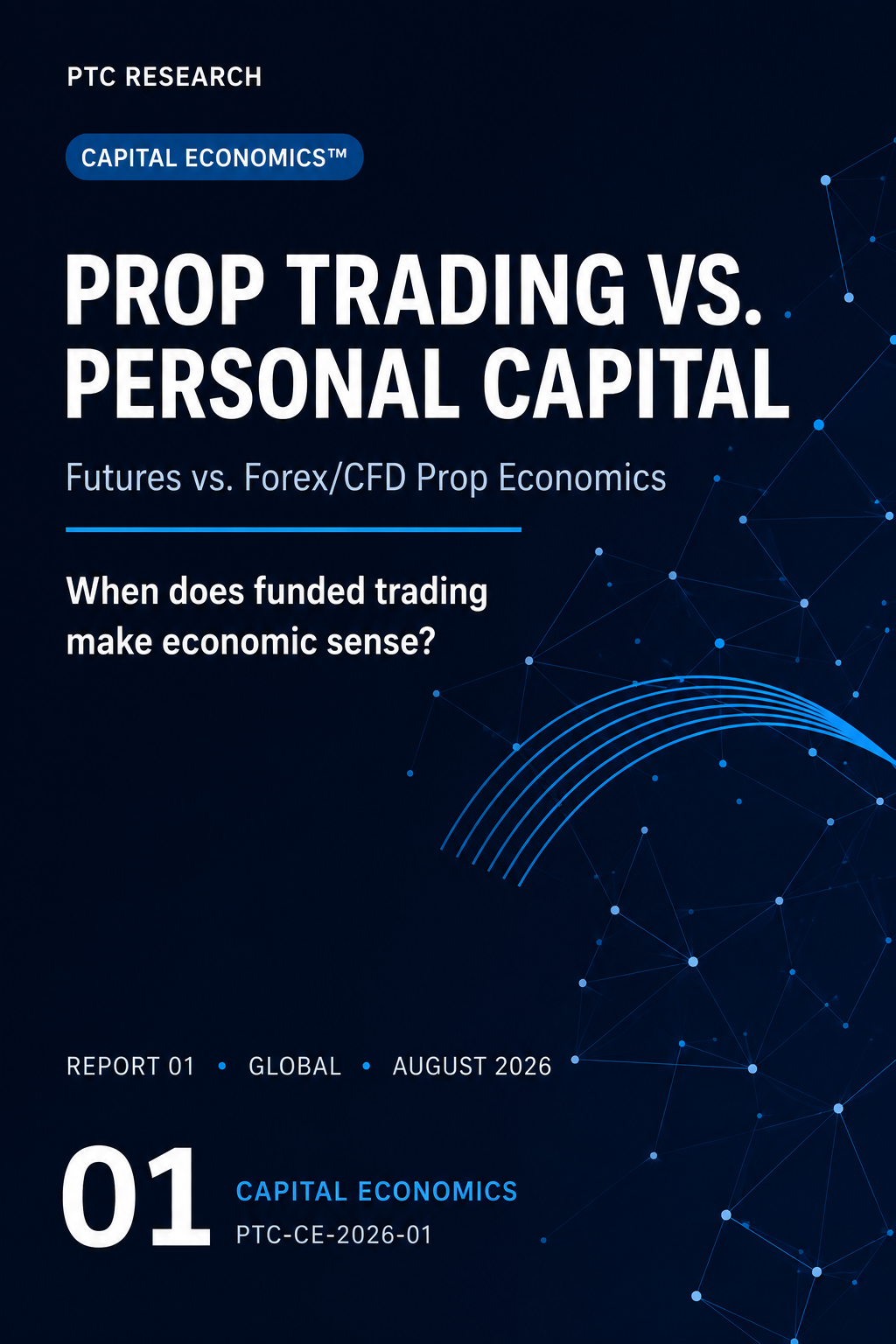
PTC Research
CAPITAL ECONOMICS™ · Report 01
Prop Trading vs. Personal Capital
Futures vs. Forex/CFD Prop Economics
When does funded trading make economic sense?
- Coverage
- GLOBAL
- Period
- AUGUST 2026
- Extent
- 9 pages
- Publication
- PTC-CE-2026-01
Read the report (PDF) ↓PDF · 9 pages
Reviewed by PTC editorial staff· 24 August 2026
What this report covers
PTC examines when proprietary trading offers a stronger economic proposition than trading personal capital, comparing futures and Forex/CFD funding structures through effective risk capital, evaluation costs, payout economics and strategy compatibility.
- Effective risk capital
- Evaluation and funded-stage pricing
- Drawdown architecture
- Payout mechanics and cost to first payout
- Account capacity and scaling
- Hybrid prop and personal-capital routes
What the research found
- Headline account size is a poor unit of comparison; effective risk capital is the operative number.
- Cheap entry is not the same as cheap risk capital.
- Cost to first realized payout is the more relevant capital-efficiency milestone.
- Strategy fit with drawdown architecture can dominate sticker price.
- Prop capital is a capital-access route rather than an asset in itself.
Important disclosure
Structural economics research — not investment advice or a firm ranking.
This edition excludes the known-invalid low-capital scenario cells and does not publish a universal break-even capital threshold. Secondary sources are used only where an official source could not be retrieved and are labeled INDICATED.
PTC-CE-2026-01 · Research cutoff 14 AUGUST 2026